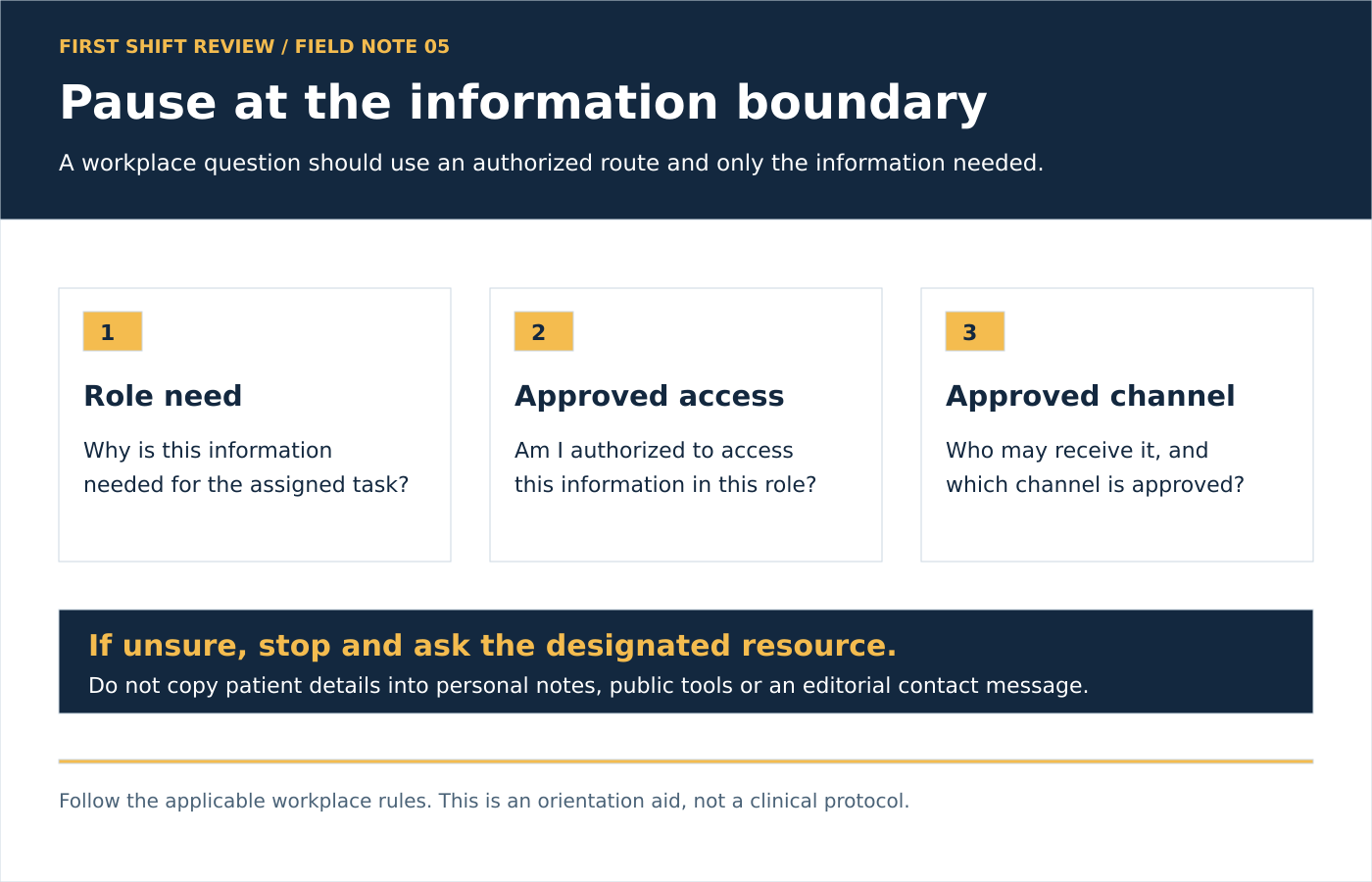
Working in healthcare does not create a general permission to look up patient information. Begin with the work you are assigned to do, the access authorized for that role and the employer’s approved communication methods. If the reason for a particular use is unclear, ask through the local privacy or supervisory process before improvising.
HHS guidance on minimum necessary information explains role-based limits on workforce access. It also identifies an important distinction: disclosures to, or requests by, healthcare providers for treatment are exempt from the minimum-necessary requirement. That exception is not a general permission to browse records out of curiosity. The actual permitted workflow still depends on applicable rules and employer policies.
Four ordinary moments that deserve care
- Someone is familiar.
- Recognizing a name does not itself create a work reason to access a record. Keep curiosity separate from an assigned task.
- A message needs clarification.
- Ask which approved channel and recipient should be used rather than moving patient details into personal messaging because it is convenient.
- You want an example for learning.
- Ask the educator how to discuss the situation appropriately. Do not copy a record or take a photograph for a personal study folder.
- A family member asks about work.
- Describe your own day without identifying a patient or sharing private details. A story can reveal someone even when their name is omitted.
Security instruction is part of learning the job
The HHS Security Rule summary explains that regulated organizations must train their workforce on security policies and procedures and authorize electronic information access appropriately. That is a reason to learn the actual employer process, rather than rely on a generic internet list of what is “HIPAA compliant.”
Ask where you find approved instructions, how to report a suspected misdirected message and whom to contact when access seems broader than your work requires. This article cannot audit the organization’s systems, confirm that a particular app is approved or decide whether an individual disclosure is legally permitted.
Use a fictional example without real identifiers
Imagine a new office worker is asked to clarify an appointment issue. They are unsure whether the colleague requesting details is assigned to that workflow. The appropriate next step is to verify the work purpose and approved route, not to copy the patient’s record into a personal email so the conversation can continue after the shift.
For training discussions, keep examples fictional unless your educator has provided an authorized method for discussing actual cases. Never send this publication patient records, images, case screenshots or stories containing identifiable details. Our correction process can receive a page URL and a factual criticism without any patient information.
Do not wait for an article when a real incident occurs
If information has already gone to the wrong place, use the employer’s established reporting process promptly. Do not hide the event, delete records to make it disappear or assume that a private message to a colleague is the formal report. A local privacy or security team is equipped to assess the actual circumstances; an independent editorial site is not.