A professional credential, employer access and local task readiness are three different things. You may hold the right professional license and still need employer onboarding. You may have a badge and still need role-specific instruction. Neither fact should be used as a shortcut around the other.
For one concrete example, New York’s RN licensing guidance sets professional requirements, while a public Northwell Med Surg RN posting in Manhasset names a New York RN license and its own education conditions. This does not establish the rules for every profession or location. It shows why the regulator and the exact job description both matter.
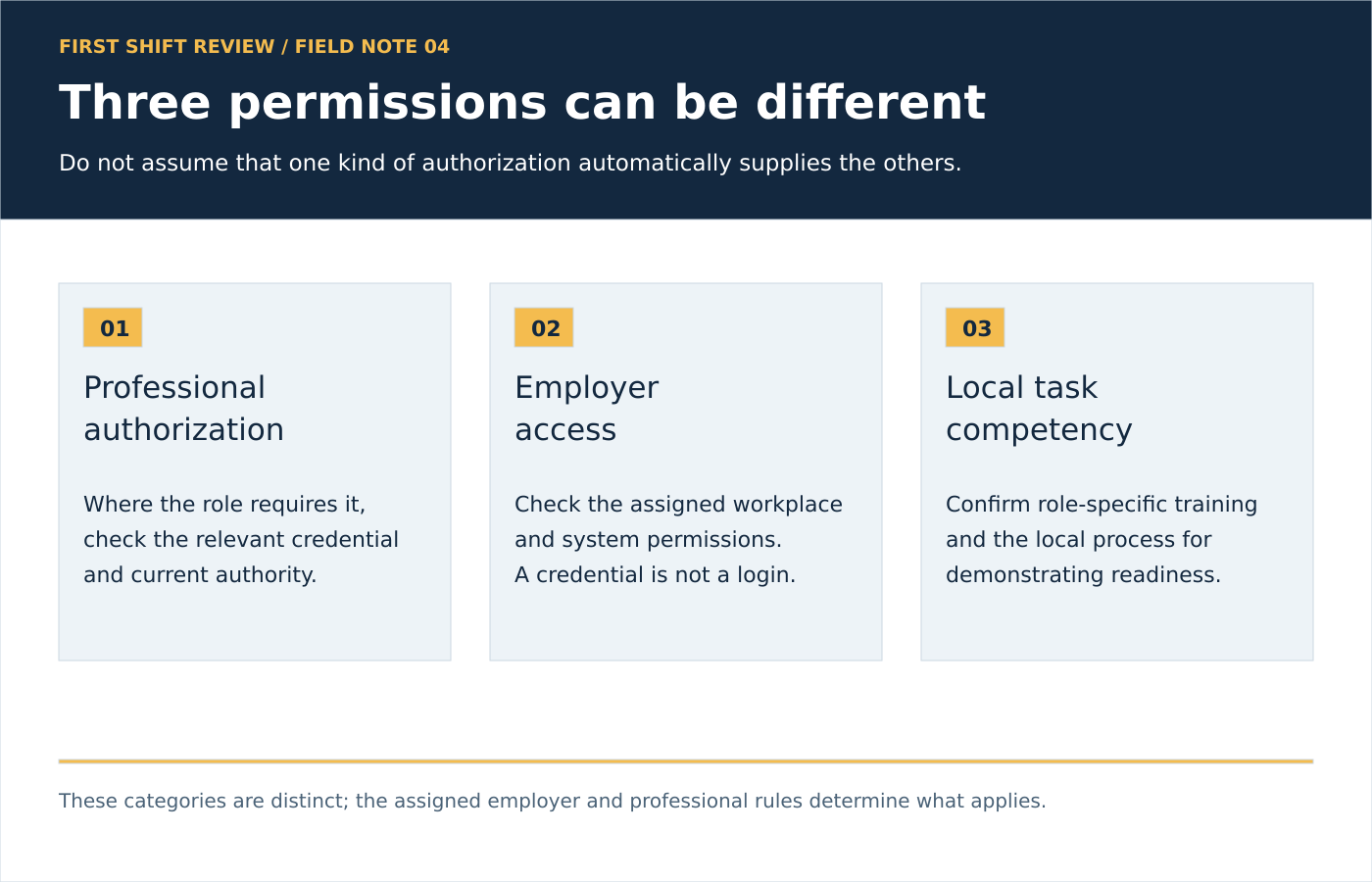
Layer one: professional authorization
Identify the profession and jurisdiction before checking a requirement. A national certification, an academic degree and a state professional authorization are not interchangeable labels. If you move into a different state, specialty or role, ask the appropriate regulator and credentialing contact what applies rather than assuming your current document answers everything.
This guide does not decide your scope of practice. It helps you recognize when the next question belongs with a professional regulator or authorized credentialing resource instead of a general IT or orientation contact.
Layer two: employer access
A building badge or system account enables a kind of access. It should not be read as a universal statement about what you may do once inside. Access can also be incomplete without proving that the underlying professional credential is deficient. Ask the designated local contact which access is required for your assignment and how an access problem should be reported.
A useful message describes the missing function and the assigned work context. It does not ask a colleague to share a password or open a record under their account. Temporary workarounds that bypass the authorized process can create a different problem while leaving the original one unresolved.
Layer three: the local task and its supervision
Before a task you have not performed in this setting, find out who provides instruction, which procedure is authoritative and how readiness is confirmed. Someone saying “you have done this elsewhere” is not the same as knowing the local equipment, workflow or authorized scope. An independent career article cannot supply that missing authorization.
In a fictional onboarding example, an experienced professional has an active credential and a working badge, but has not completed the local equipment orientation. The remaining question is specific: which approved instruction and supervision apply before using that equipment? There is no need to reinterpret the license or assume that the badge resolved the training gap.
When the problem changes, change the resource
- Unclear professional status: the relevant regulator and credentialing process
- Missing employer access: the verified local access/support route
- Unfamiliar task: the assigned supervisor, educator or other authorized role lead
- Immediate safety concern: the workplace’s established urgent response route
The goal is a clear boundary, not a stack of copied certificates. Keep credential details in the authorized process and avoid sending documents to this publication. For the separate issue of accessing patient information, read the workplace privacy map.