Joining Northwell is easier to understand when you stop treating “onboarding” as one finished-or-unfinished task. An offer, permission to start, a welcome session, local orientation and readiness for a particular task answer different questions. A message about one does not automatically settle the others.
Northwell’s 2021 account of its onboarding teams describes coordination among recruitment, health-clearance, HR, security and orientation resources. That historical account helps explain the functions involved; it is not a current checklist for every job. Use the milestones below as an editorial map, then let your assigned contacts confirm the process that applies to you.
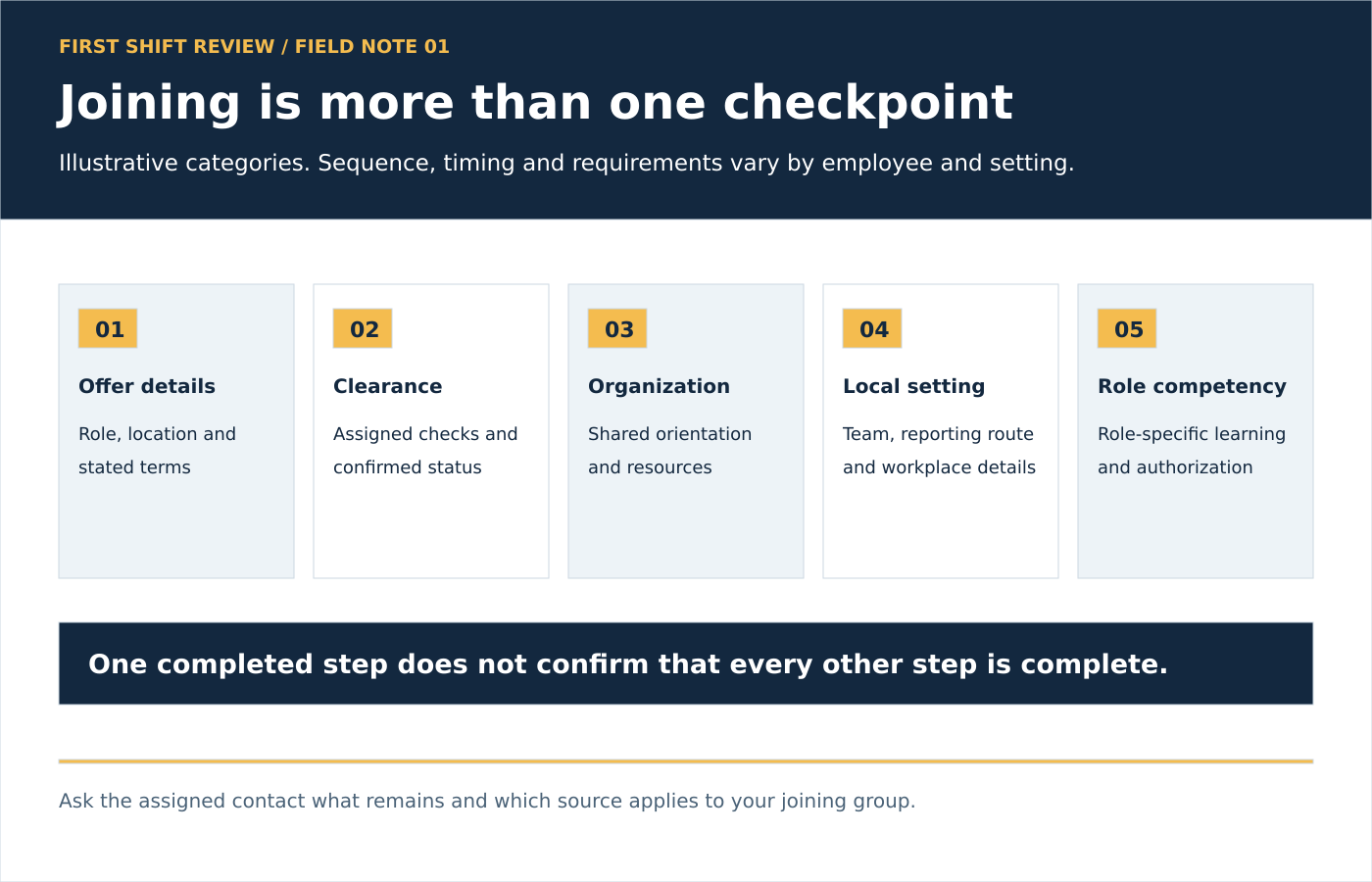
Five milestones, five useful questions
- The role is identified. Which position, employing organization, work location and agreed terms do the offer materials describe? A job advertisement is background, while your individual materials need their own review.
- The required checks are resolved. Who will tell you that the necessary pre-start conditions have been met? Completing something on your side is different from the responsible team accepting it.
- The organization welcomes you. Which orientation session are you assigned to, in what format, and with what preparation? A publicly listed session is not proof of your assignment.
- The local workplace introduces its routines. Where do you report, who receives you and which local instructions apply? A central welcome session cannot answer every department question.
- The role’s learning and authorization are clear. What may you do, what still requires supervision, and who confirms readiness? Reading a task description is not a competency assessment.
Use the smallest unresolved question
“Is everything done?” is difficult to answer when several teams own different checks. Replace it with a question that names the particular uncertainty. For example: “I have completed the appointment listed in my instructions. Which team confirms that its result has been accepted, and should I wait for that confirmation before attending the assigned start date?” Do not include medical results in a general scheduling message.
Likewise, “Where do I go Monday?” may contain two questions: the location for organization orientation and the location for departmental reporting afterward. Ask which event each address belongs to. If an appointment date and a start date appear inconsistent, show the assigned contact those dates through the established channel rather than choosing one from a public webpage.
A joining conversation you can actually use
This fictional example illustrates how to separate progress from authority. A new administrative employee has accepted an offer, attended a screening appointment and received an orientation invitation. They have not been told where to report for department training. The useful conclusion is not “ready for all duties.” It is: the offer and invitation are known; clearance confirmation and departmental arrangements still need their own answers.
- Ask the assigned preboarding contact whether anything still blocks the authorized start
- Check the invitation for the exact orientation session and attendance instructions
- Ask the local leader who will explain the first department day
- Keep any task you have not been trained or authorized to perform out of the “I can do that alone” category
Keep your private information out of the map
The comparison tool below contains general stage descriptions. It asks for no identifiers, health details or documents, and it does not submit an onboarding case. You can compare stages without recording any personal information. Your employer’s verified process remains the place for required forms and confirmations.
Find the question for your next checkpoint
Compare up to three joining or workplace stages. Each has different questions, preparation and boundaries. These stages organize this independent guide; they are not an employer-mandated sequence or a personalized checklist.
Read every stage without the comparison
Before an authorized start
- The question at this stage
- Which requirement or confirmation remains unresolved for the position you accepted?
- What to prepare
- Your assigned instructions, the specific task and the date or arrangement needing clarification; keep health and identity documents in their authorized channels.
- Resource to verify
- The assigned recruitment or preboarding contact; the designated specialist for a particular check.
- Important boundary
- Our categories do not confirm clearance. Completing your part is different from the responsible team accepting it.
- Sources checked
- September 30, 2026
- Public sources
Organization orientation
- The question at this stage
- Which welcome session are you actually assigned to, and how should you attend?
- What to prepare
- The individual invitation, format or location, arrival instructions and a specific question about conflicting details.
- Resource to verify
- The orientation contact identified in your verified invitation.
- Important boundary
- The public Manhattan Beginnings page is one location-specific example, not every new hire’s schedule.
- Sources checked
- September 30, 2026
- Public sources
Local and role learning
- The question at this stage
- Who introduces the actual setting and confirms the training or supervision your tasks require?
- What to prepare
- The assigned department or site and the particular task or access question; no patient examples are needed in a public tool.
- Resource to verify
- The local leader, educator, credentialing or access resource appropriate to the issue.
- Important boundary
- A credential, badge and local task competency are separate. This tool authorizes none of them.
- Sources checked
- September 30, 2026
- Public sources
A different work pattern
- The question at this stage
- How do location, regular shift, training and temporary arrangements fit together?
- What to prepare
- The relevant role or assignment and the exact dates, hours or reporting-place question.
- Resource to verify
- The person authorized to explain the assignment and training arrangements.
- Important boundary
- A shift, hybrid or temporary label is not a complete schedule, benefit determination or pay rule.
- Sources checked
- September 30, 2026
- Public sources
Using a workplace resource
- The question at this stage
- Which benefit or support service applies to your employee group and the outcome you need?
- What to prepare
- The program name, applicable audience and the availability or eligibility question; avoid unrelated sensitive details.
- Resource to verify
- The official benefits or service contact named in your current applicable materials.
- Important boundary
- A public overview does not confirm eligibility, a reservation, confidentiality terms or an individual entitlement.
- Sources checked
- September 30, 2026
- Public sources
After employment
- The question at this stage
- Do you need a specific verification or do you want a voluntary alumni connection?
- What to prepare
- The purpose, requested process and deadline; submit identifiers only through the verified official route.
- Resource to verify
- The former-team-member or specific form route in Northwell’s public FAQ; alumni information for community participation.
- Important boundary
- This publication cannot verify employment, retrieve accounts or determine loan-forgiveness eligibility.
- Sources checked
- September 30, 2026
- Public sources
Selections stay on this page. This tool does not send or save them. No employment, patient or health details are requested.
For orientation-day questions, start with the distinction between Beginnings and department training. For a question about an acquired practice, use the transition-specific guide instead of assuming that page describes every hire.